
‘Who’s who’ of industry leaders attend alive Executive Summit
By Bruce W. Cole
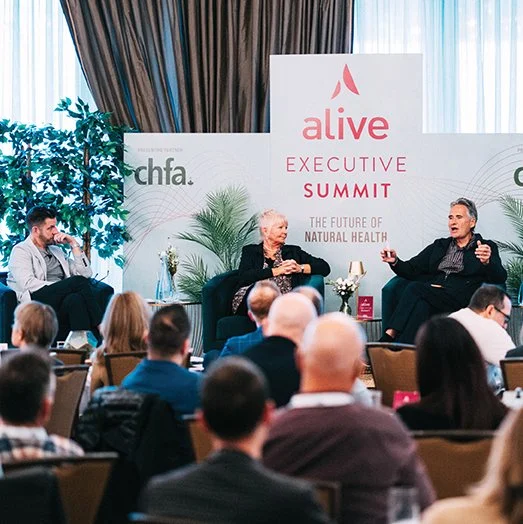
The alive Executive Summit once again attracted leading figures in Canada’s natural health industry by offering a slate of inspiring presentations and essential business insights.
The event was hosted by Ryan Benn, CEO and group publisher of Alive Publishing Group and Canada Wide Media, and Ellen Wheeler, vice president of partnerships at Alive Publishing Group and publisher of CNHR magazine, who also doubled as moderator for several panel discussions and presentations.
Day one
Leading community
The summit kick-off had a “breaking news” quality, as Ryan welcomed the first guest, Vancouver-born Victor Montagliani. Named to Vancouver Magazine’s Power 50 in 2026, Victor is the president of the Confederation of North, Central America and Caribbean Association Football (CONCACAF) and vice president of Fédération Internationale de Football Association (FIFA).
As a hugely influential figure in global soccer, and with Vancouver set to host matches during the upcoming FIFA World Cup, Victor was invited to speak about the role major sporting events play in bringing people together.
When asked what community means to him, Victor explained that it is quite simple: “The first thing I did was put the game first. The ball connects the 22 players on the field, along with the thousands in attendance at the stadium, and the millions of viewers watching on TV. I told my team that every decision we make has to be good for the game. If you do that, the sport will take care of everything else. The game breaks down walls. Events like this are crucial to building community.”
Inside the shift: A look at where we’ve been and where we are going
Likely for the first time in the history of the Canadian natural health industry, the summit fielded a panel made up exclusively of people named Matt. Or Mathew. Or Matthew. The topic was “Inside The Shift: A Look At Where We Have Been and Where We Are Going,” and Matt (LeBeau), Mathew (Holtmann), Matthew (James), and Matthew (Breech) offered in-depth observations about the industry from a retailer, distributor, and broker perspective.
In terms of market trends and channels, panellists commented the following:
E-commerce is getting bigger and social media is driving consumer trends.
Successful online brands want a presence in brick-and-mortar stores, while successful brick-and-mortars want a presence online.
Independent retail channels remain healthy, vibrant, and successful.
Consolidation in the industry is creating new opportunities.
When it comes to consumer behaviours and loyalty, panellists shared several observations:
Customers are loyal to solutions rather than brands. Brand loyalty is declining, with consumers jumping around more.
It’s important to meet customers where they are, be it in store or online.
Panellists also discussed innovation and strategy in the industry:
The industry is highly adaptable and constantly evolving. Innovation is its lifeblood and the key to survival.
There is more innovation in food than supplements.
Vendors must find pricing that works for both traditional health food stores and Amazon while curating brands that meet the needs of retailers—regardless of what their strategies are.
Channelling AI can drive innovation.
Companies should determine their competitive advantage.
Finally, on retail and brand dynamics, panellists noted:
The strength of traditional health food stores lies in passion.
Healthy independent stores are vital for brands to build their business before expanding to other channels. At the same time, the relationship between retailers and brands has evolved, partly due to a power shift: brands can now speak directly to consumers and drive traffic to retail or Amazon.
Trust, transparency, and tradeoffs
CHFA’s President and CEO Aaron Skelton and VP of Marketing and Communications Lynsey Walker presented a condensed version of Trust, Transparency and Tradeoffs, a recent CHFA study conducted with Canadian consumers.
Some key points from their presentation revealed:
Canadians aren’t rejecting natural and organic—they are questioning it.
There has been an erosion of trust over the past few years.
Adding more claims doesn’t build trust.
Transparency will be key.
Storytelling will be the amplifier.
Better data makes for a stronger industry.
The business of doing good
Linda and Dale Bolton are known by many for their co-ownership of Natural Calm Canada, but perhaps they are even better known for their many charitable efforts in Africa and South Asia through their organization Thrive for Good.
Alongside James Woller, the international executive director of Thrive for Good, Linda and Dale took the opportunity to highlight their work to Summit attendees. This includes equipping communities with training, tools, and knowledge to grow their own nutritious food to improve health, reduce medical expenses, generate income opportunities, and build long-term food security and resilience through Life Gardens.
For over 20 years, Alive Publishing Group has supported Thrive for Good, championing sustainable, community-led solutions to food insecurity. At this year’s summit, that support took on a powerful new form: Alive announced that it has committed $30,000 to this campaign and is inviting Canada’s natural health community to stand alongside them by matching that investment. Every contribution will be matched dollar-for-dollar, up to the full $30,000—a collective opportunity to align business, wellness, and global impact.
From influencer to impact
Before the day ended, Darcy Matheson, editor-in-chief at <BCBusiness> and vice president of digital for Canada Wide Media, moderated the“From Influencer to Impact” session with media personality Jillian Harris.
Their conversation touched on everything from staying authentic and dealing with internet trolls to how Jillian chooses the brands she partners with for her curated subscription boxes called The Jilly Box. “Most of the boxes’ products come from women-led local businesses,” Darcy noted during their talk. “In fact, the Jilly Box Inc. has been named one of the fastest-growing women-led businesses in Canada by The Globe and Mail,” with each quarterly drop of 20,000 boxes selling out within 24 hours.
Day two
Alive insights: hear it straight from your customers
Nina Wagner, group vice president of publishing and operations at Alive Publishing Group, highlighted the work—and results—of alive Research, a branch that produces exclusive insights into the natural product buying patterns of Canadians across the country.
Nina explained that the community’s 10,000 highly engaged members are <the> opinion leaders, stating: “Their attitude is, ‘I’m not a patient, I am in charge of my health.’”
A composite of this membership is 42 years old, university educated, married with children, and part of a household with an annual income of over $100,000. “She is 12 to 18 months ahead of mass trends, and she is fiercely loyal to brands that respect her,” explained Nina. This composite’s sphere of influence is vast: “She influences five to 10 other shoppers through word-of-mouth.”
Directing her presentation to the retail community, Nina pointed out that currently, a big issue is burnout. “People of all ages are feeling mentally depleted,” she explained. “Train your staff to ask the right questions and be non-judgmental. People want clarity and focus, and they are turning to supplements for answers. So, personify their experience, speak their language, earn their trust.”
Practical AI insights for senior leaders
Rival Technologies, a platform that helps businesses talk to their consumers in a chat-style format to get feedback quickly, delivered a session titled “Practical AI Insights for Senior Leaders.” The two-hour presentation was led by the platform’s co-CEO Andrew Reid and AI builder and Program Director Shannon M. Farley, as well as management pro Brittney Smaila.
Together, they explored how leaders are using AI to advance their businesses, while emphasizing the importance of understanding industry-specific guidelines before implementing the technology. Interestingly, roughly half of the summit attendees use AI in some way, shape, or form. Before concluding their talk, the speakers also highlighted three core areas where AI delivers return on investment: time savings, cost savings, and quality lift.
In her own words
The Canadian natural health industry has always been a woman-driven community, comprised of female owners, senior executives, and sales leaders. And for the past year, Ellen Wheeler, vice president of partnerships for Alive Publishing Group and publisher of CNHR, has been bringing the stories of our industry’s women to the forefront through her column In Her Own Words.
During the summit, Ellen invited two women who have been featured in her column to the stage: Brenda Kirk, senior vice president of health and wellness at Pattison Food Group, and Andrea Benson, country leader/president of Puresource, A NOW Health Group Company to the stage. Both women shared stories of climbing the corporate ladder in a world often dominated by men, discussed best practices for supporting female teams, and the importance of mentorship for young women in the industry. They concluded the discussion by sharing their thoughts on how women approach challenges and situations in business, which they felt was often in a completely different manner from their male counterparts.
The customer journey: from consumer to community to fan
In a session moderated by Ryan, Michael Doyle, president of both Canucks Sports & Entertainment and Toptable Group, shared his thoughts on loyalty, engagement, and community.
“Loyalty is created emotionally first, transactionally second,” he said. “Customers become fans when they feel belonging, identity, and hope connected to a brand. Authentic locality drives loyalty more than operational efficiency.”
From a sports perspective, Michael said people aren’t buying tickets only for entertainment: they are buying hope. “Fans emotionally invest in the team’s future success. This shared hope creates community, and community creates long-term engagement. Once emotionally invested, customers spend more on secondary experiences.”
Michael’s operating philosophy in business includes:
Hire passionate people (they’re harder to replace than customers).
Be authentic—people want real connection.
Invest in community outreach and charity.
Build belonging before trying to drive revenue.
“You don’t create loyalty with marketing,” he said. “You create it throughlocal connection, passionate staff, authenticity, and shared identity. Customers move from consumer to community member to fan, reducing price sensitivity.Independent retailers win by becoming a place customers identify with, not just shop at.”
“Support local suppliers, empower staff relationships, be visible in the community, and focus on belonging, rather than promotions,” he said in closing.